Declared Transactions
Maintaining Matched transactions in the jvmguard VM group configurations is an extra step in the development workflow and can get easily out of sync with the actual code. While Matched transactions are necessary for external classes, it is much more maintainable to directly annotate the methods and classes of interest in your own code.
Transactions defined this way are called Declared transactions, because you declare them explicitly in your source code with the jvmguard annotations.
The jvmguard annotations are located in the JAR file api/jvmguard-annotations.jar, see the
javadoc overview for how to download this JAR file with Maven or Gradle.
All annotations have a class retention policy. This means that they are present in the class file, but the JVM does not load them into memory. Code that queries runtime annotations on a particular method cannot be confused by the additional jvmguard annotations because they are only detected by jvmguard at the class loading stage and do not appear in the loaded class objects.
The usage of Declared transactions is described in detail in the Javadoc of the
@MethodTransaction and
@ClassTransaction annotations. The Javadoc is also present
in the api/doc directory of the jvmguard installation.
Policies
Section titled “Policies”The Declared transaction annotations only define the transaction naming, but not the policies for transactions. Policies are closer to the operation side and often need to be adjusted in production.
It is possible to select different Declared transactions in the jvmguard configuration by way of the group name. Each Declared transaction annotation can have a “group” parameter that is set to the empty string by default.
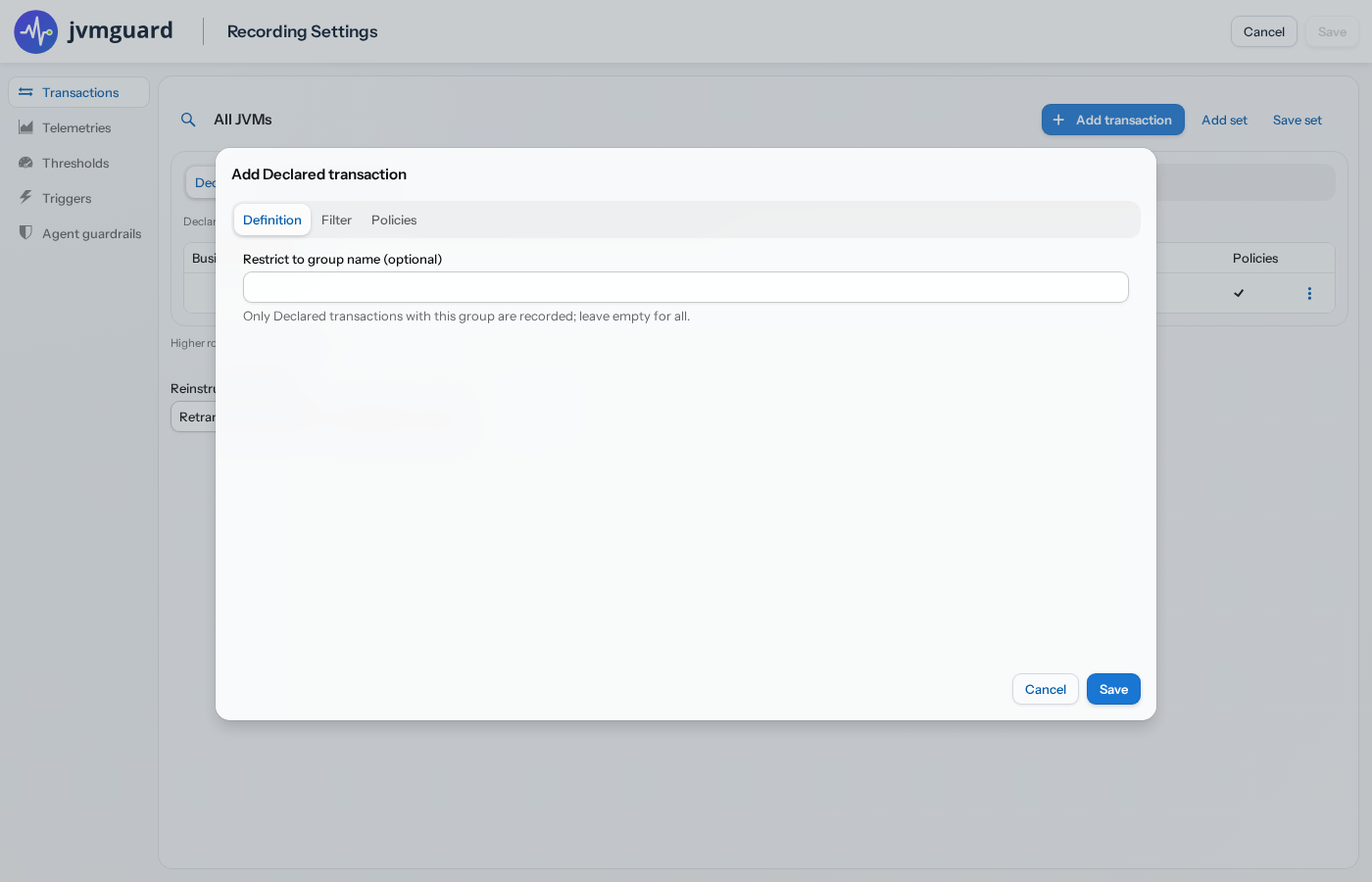
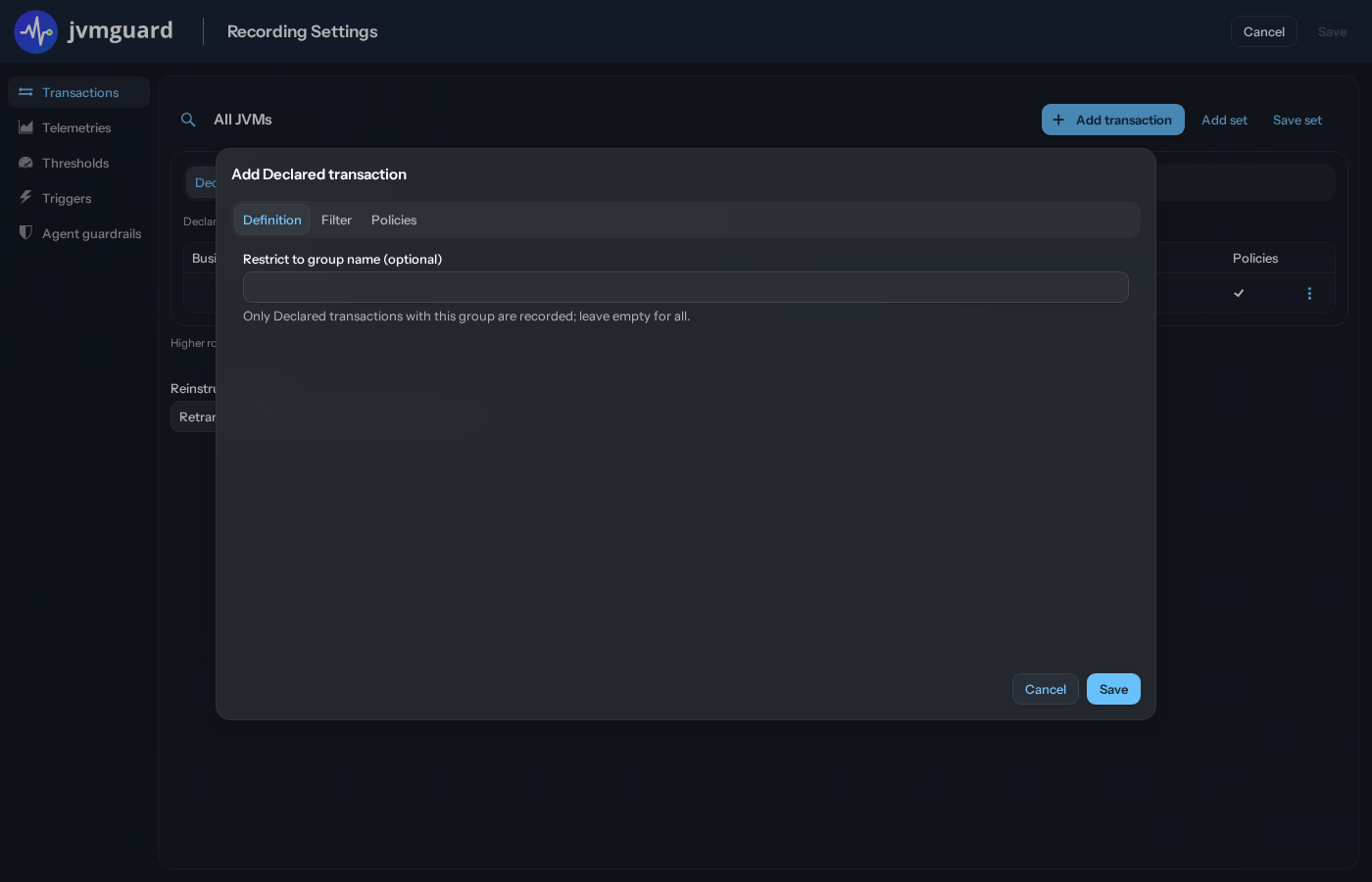
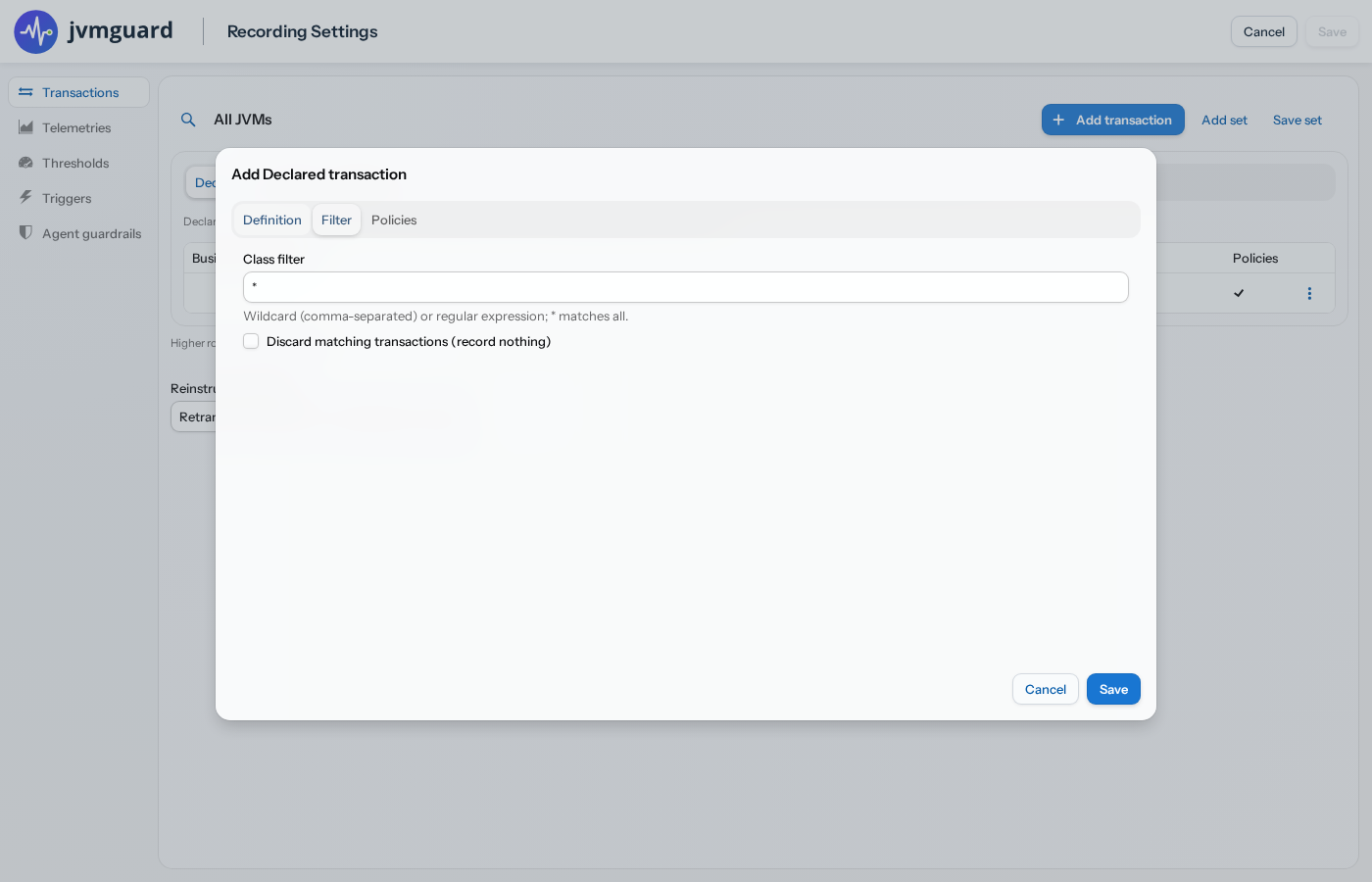
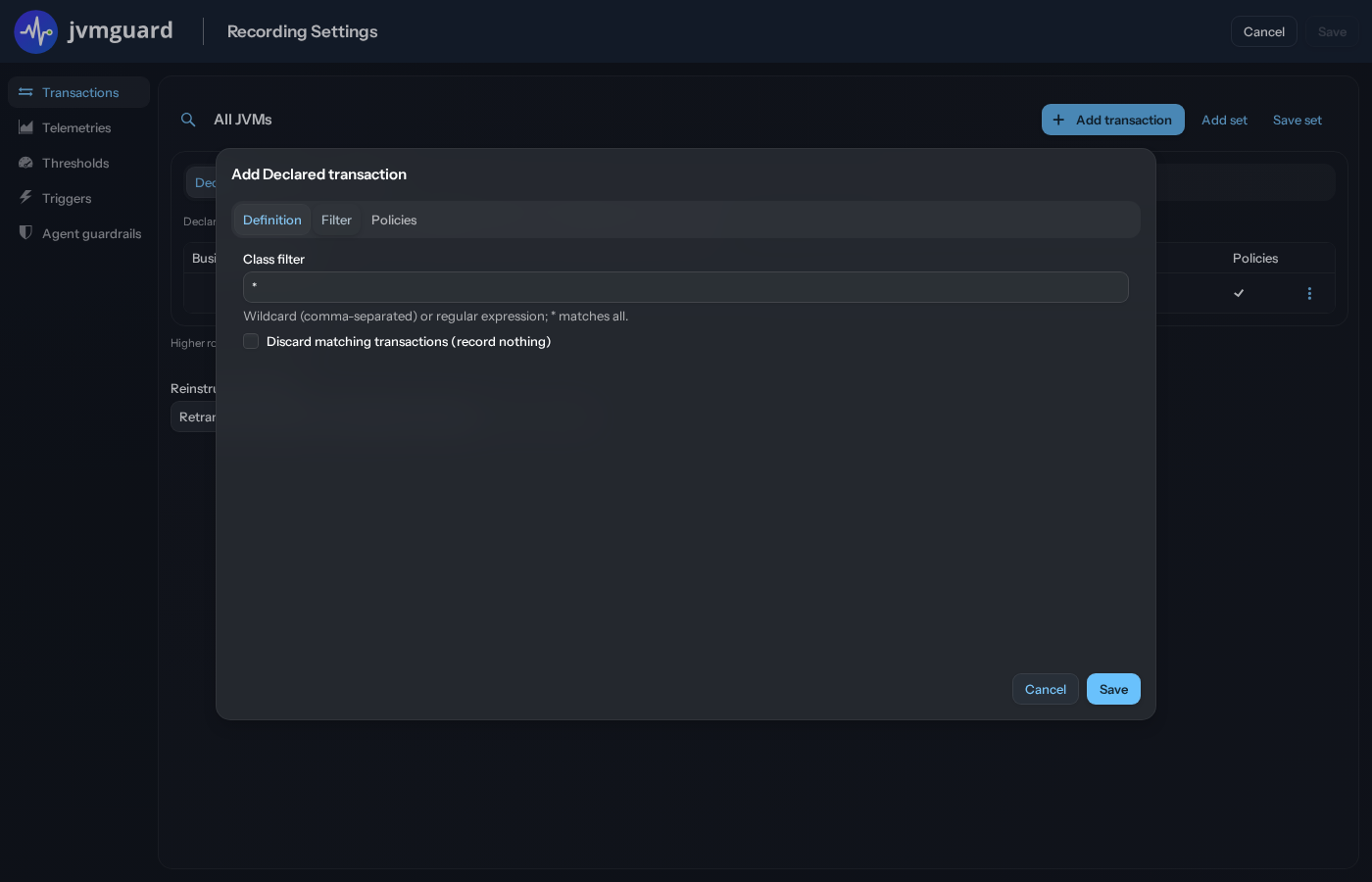
If the configured groups are not granular enough or if you want to single out a particular class, go to the next step to add a class filter. Here, it is also possible to discard all Declared transactions that originate from the selected group and classes.
On the last step of the wizard, you define the policies for the selected Declared transactions. As with other transaction types, it often makes sense to keep a catch-all transaction definition at the bottom and add more specific transaction definitions at the top.