Mapped Transactions
Many frameworks use annotations for designating important classes and entry points that could be turned into transactions in jvmguard. With the “Mapped invocations” transaction type you can let jvmguard do this work for you.
For the OpenTelemetry and Micrometer tracing annotations @WithSpan and @Observed, jvmguard provides a
dedicated OTel transaction type with a preconfigured definition.
Method and class annotations
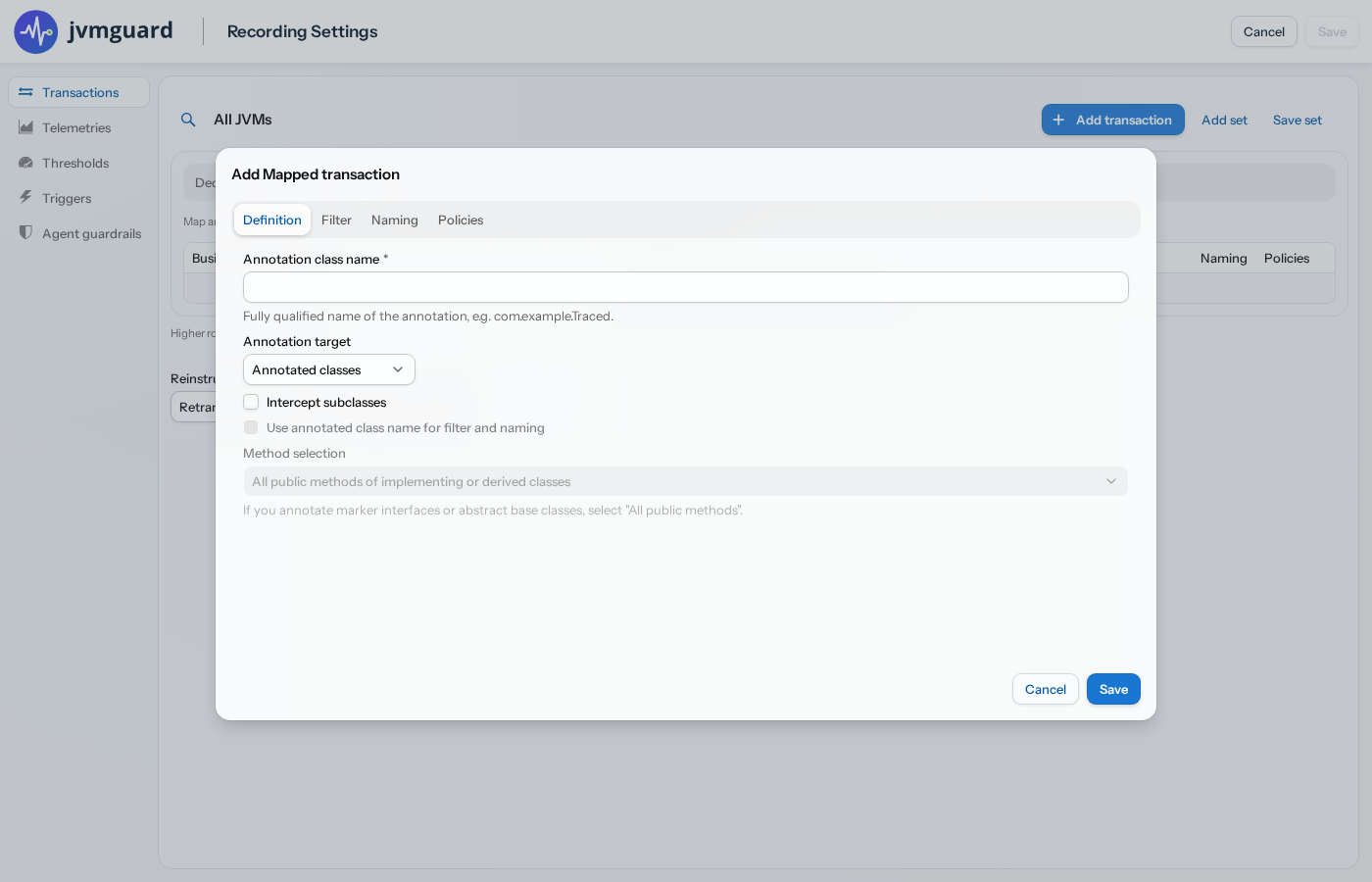
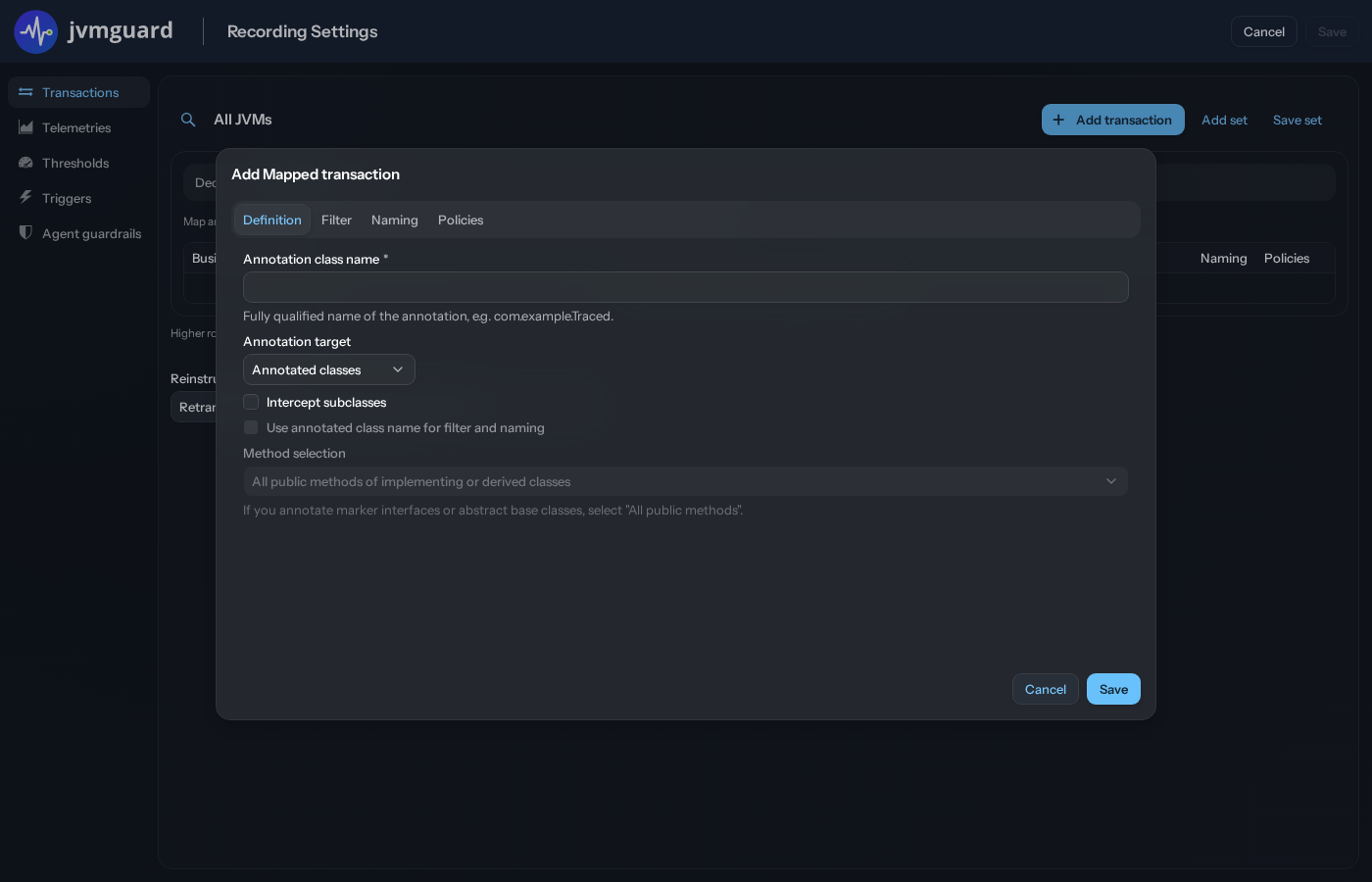
Section titled “Method and class annotations”A Mapped transaction definition takes the fully qualified class name of the annotation that you are interested in. Annotations can be either used on classes or on methods. Before proceeding with the configuration, you have to tell jvmguard for which target the selected annotation is used.
For an annotated method, each method invocation becomes a transaction in jvmguard. Annotations on classes create transactions for all calls into public instance methods.
The second choice is whether derived classes should be considered as well. For methods, it can be important to capture the time in an overridden method. For example, if a framework creates an implementing proxy class and overrides the annotated method to add database transactions, you want to intercept the method in the proxy class, and not only the annotated method.
For annotated classes, the “Method selection” options determine which methods are selected to generate transactions:
- Implementing methods only: If the annotation is placed on an interface that already defines all operations of interest with its methods, you should select this option.
- All public methods: If the derived classes have their own methods of interest that do not implement or override the methods in the annotated class, use this option to create transactions from all public methods.
Filtering by annotation values
Section titled “Filtering by annotation values”In addition to the class filter, a Mapped transaction definition can filter by the value of an annotation attribute. On the “Filter” tab, enter an attribute name and a value pattern. The value pattern is a wildcard (comma-separated) or a regular expression, just like the class filter. Only annotations where the attribute is present and its value matches the pattern create transactions.
Attribute values are read from the class file when the class is instrumented: strings are used as-is, primitives are converted to strings, enum constants are matched by name, class values by their simple name, and array values are joined into a comma-separated list.
Naming
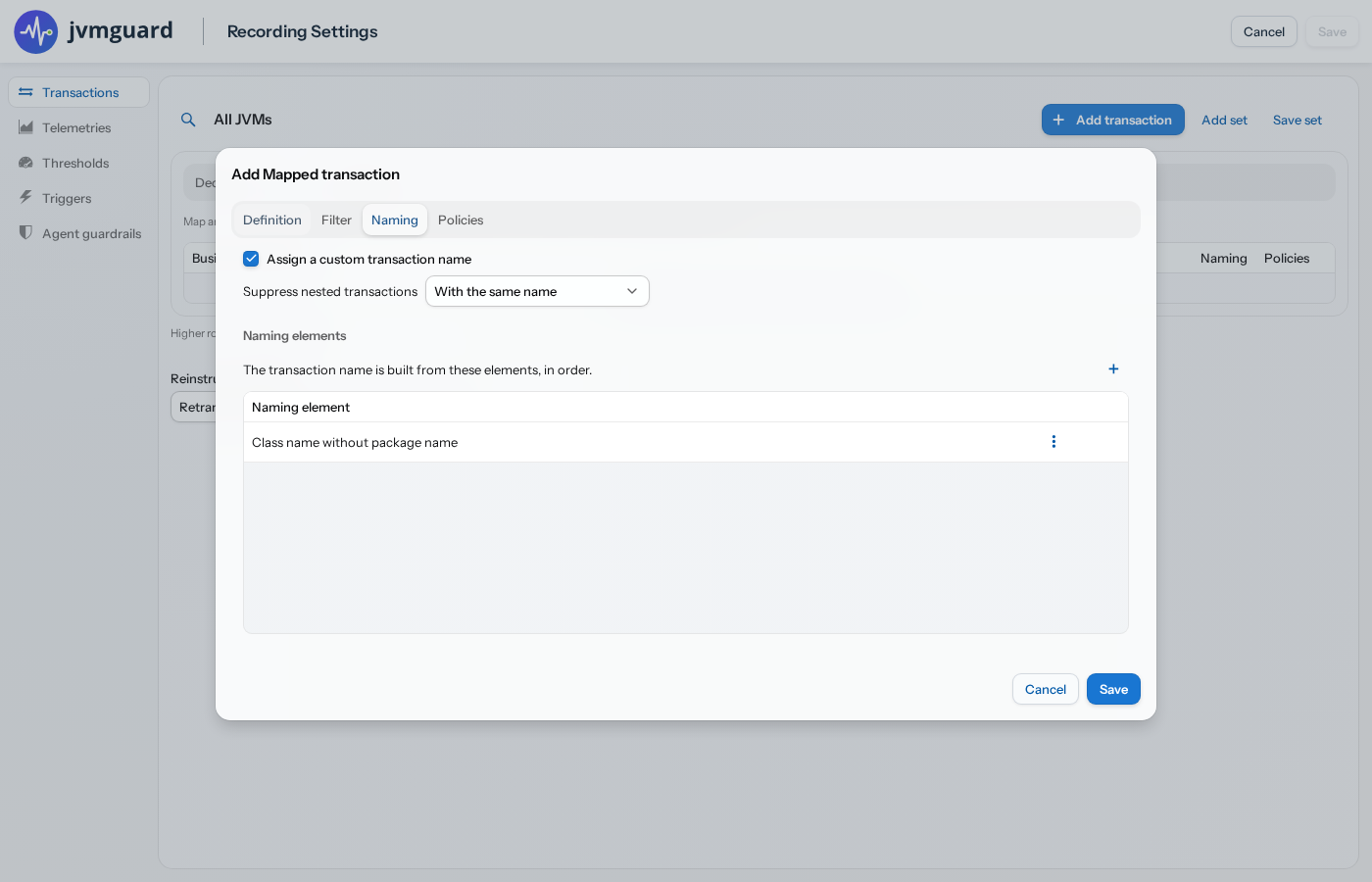
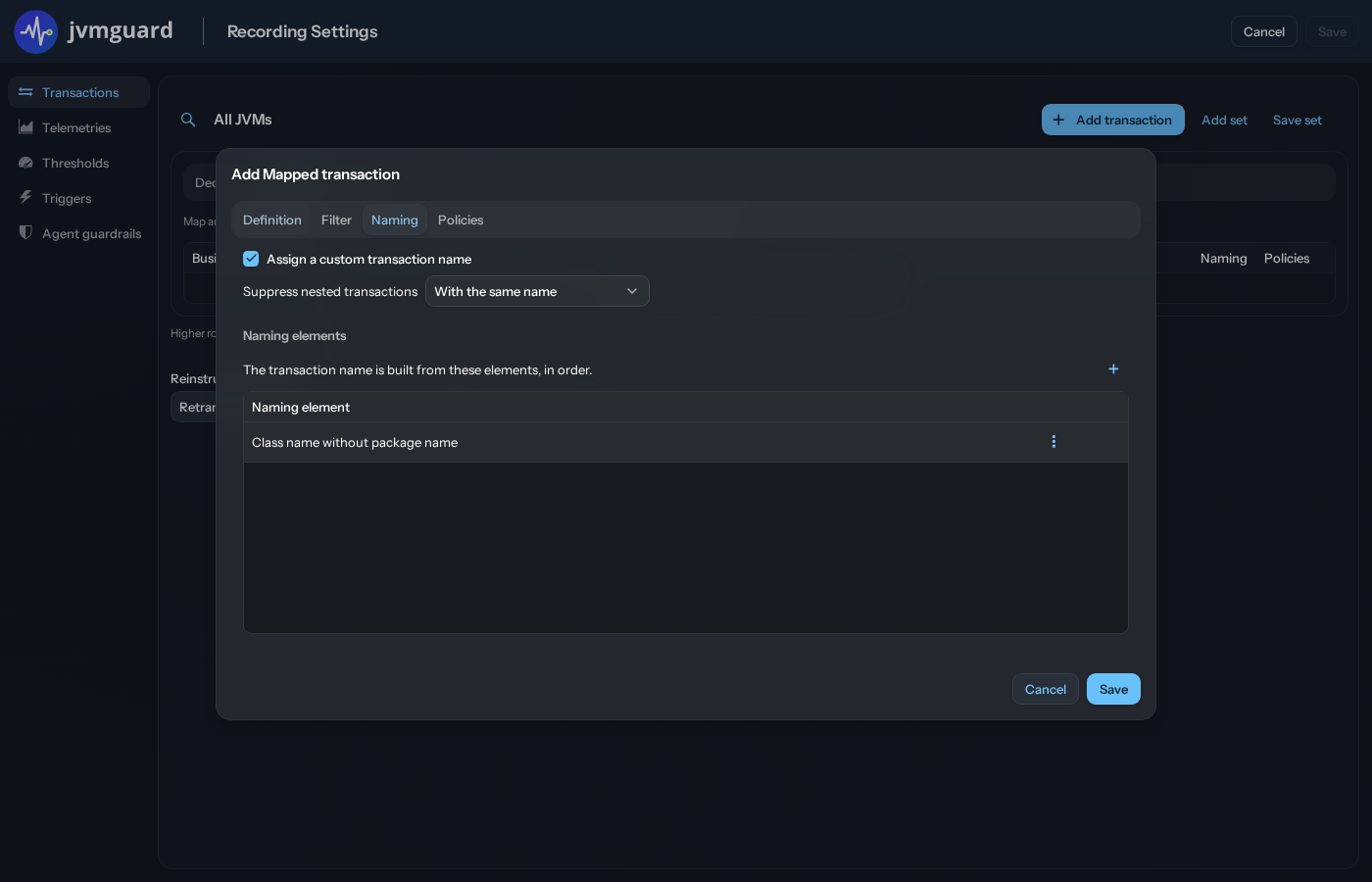
Section titled “Naming”With the “Annotation attribute” naming element, you can add the value of an annotation attribute to the
transaction name, for example the value of a @WithSpan annotation on a Mapped transaction definition for that
annotation. The value is captured when the class is instrumented. Note that if you change the naming without
retransforming already instrumented classes, the captured values are not available and the element adds nothing
to the transaction name.
When you use annotations on classes with the setting for intercepting public methods in derived classes, the question remains what class name should be used in the transaction naming.
By default, a naming element of type “Class name” adds the name of the class where the intercepted method is defined. If you want to add the name of the annotated superclass instead, select the “Use annotated class name for filter and naming” check box in the “Annotation” step of the wizard.
If you want to go the other way and add the class name of the actual instance on which the method was called, use the “Instance class name” naming element instead.
Even more specific, the “Instance name” naming element adds the toString() invocation on the object where the
transaction method was called.
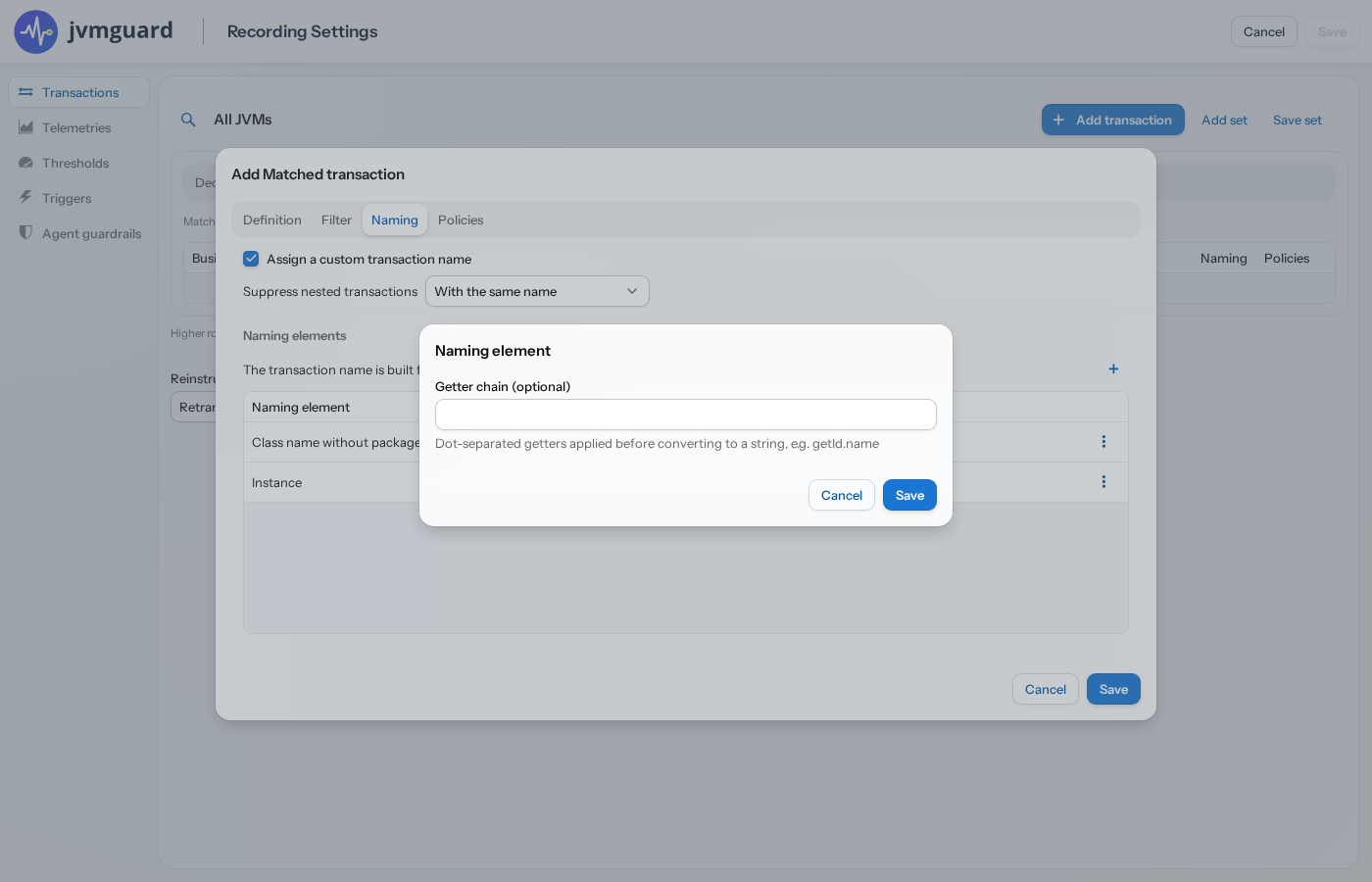
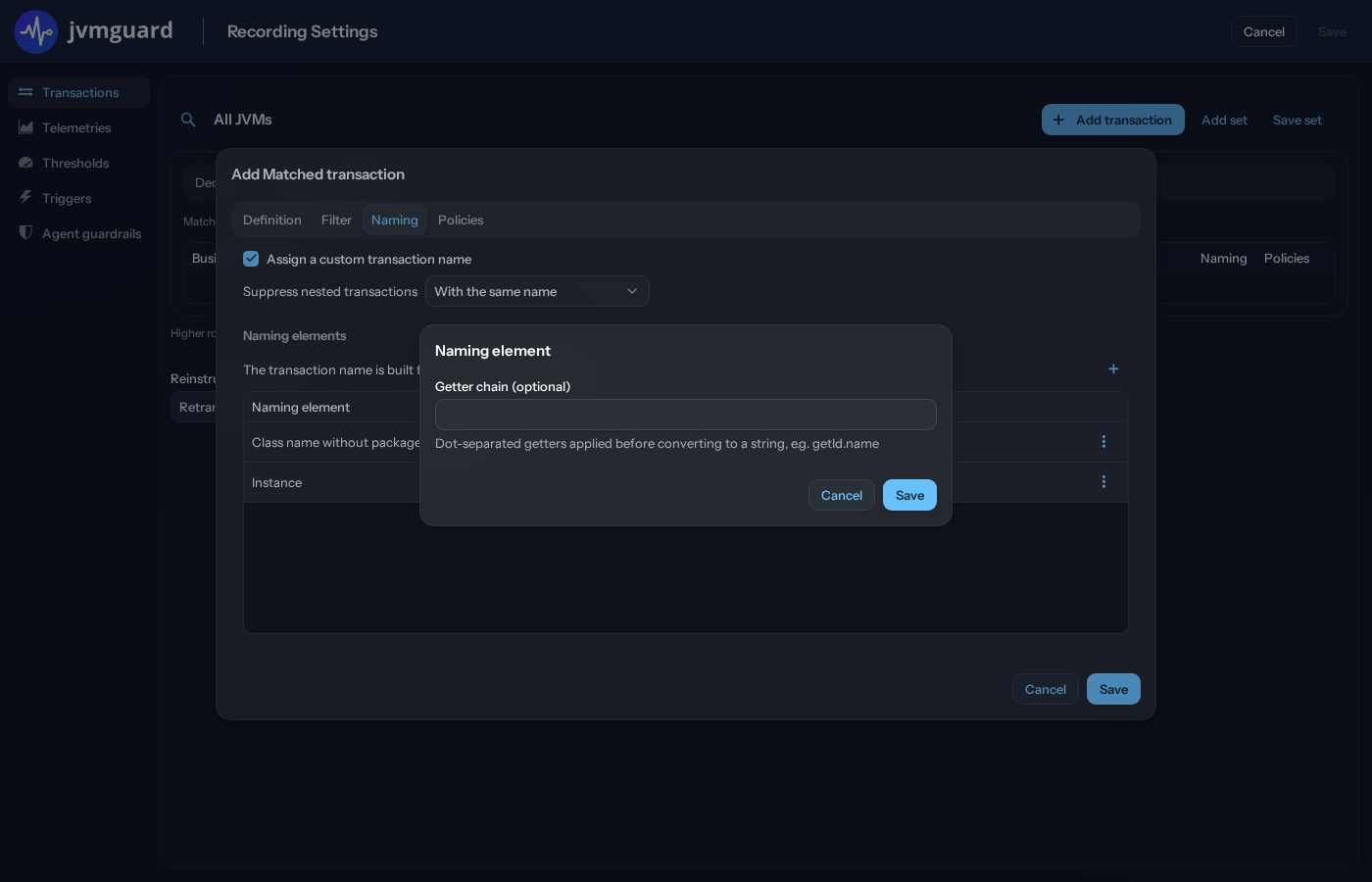
This naming element can also apply a getter chain to this object and append the toString() invocation on the result to
the transaction name instead. For example, if the instance class has a getVerbose() method that returns the desired
text, set the getter chain to getVerbose(). You can mix public field accesses and parameterless invocations of public
methods like this:
getParent().descriptor.getVerbose()If you use the getClass() method to append a class name, there are two special fields that are provided by jvmguard to
simulate the abbreviated and simple class name modes that are available for the “Class name” and “Instance class name”
naming elements:
- With getClass().simpleName, the name of the class without its package is added. For example, com.mycorp.MyClass becomes MyClass.
- With getClass().abbrevName, the abbreviated package names are added. For example, com.mycorp.MyClass becomes c.m.MyClass.
Note that the “Instance name” naming element generates a far higher overhead than the “Instance class name” or “Class name” naming elements, since it always involves actual method calls.